Louis Opländer

The Producer
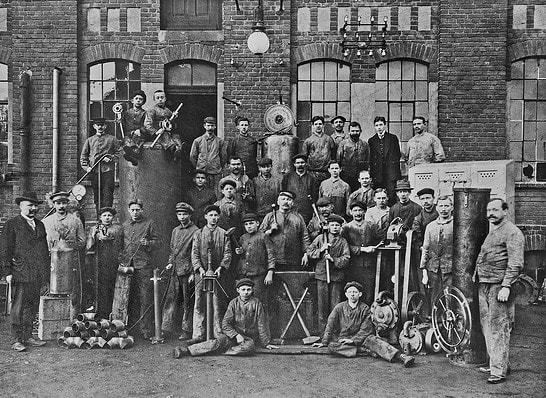
Louis Opländer’s staff and products with a machine for calculating the volume of barrels (right), two dedusting units with a transmission (to the left) and a fire extinguishing unit (back middle) around 1910.
Amid what were undoubtedly difficult times and a childhood marked by hardship, Louis took up his father Caspar Ludwig Opländer’s profession at a young age and went on to develop the technical solutions for other areas of life and fields of application, such as heating, ventilation and plumbing. It became clear that his early experience in the crafts business taught him to see the bigger picture – how things fit together.
This enabled him to transfer technical solutions to a broader scope of application. For instance, in Dortmund’s heavy industry, facilities of considerable scale were being built: on the one hand, for the heating and ventilation of the pithead baths; on the other hand, the pithead baths themselves had to meet considerable technical requirements. This is because, at that time, thousands of miners at a time needed large quantities of water at the right temperature for washing or showering after work. These systems were technically sophisticated solutions for their time.
Louis was an ingenious engineer in the truest sense, with a strong commitment to the engineering profession and a determination to develop technical solutions for the living and working conditions of the time. His technical planning always went hand in hand with an ambitious drive to improve technical processes and people’s quality of life.
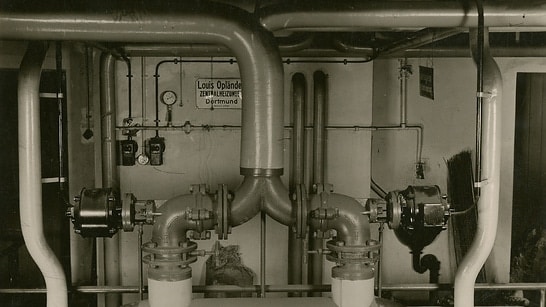
Stove heating was replaced by central heating.
His systems and equipment were designed to meet the technical requirements of their respective applications while ensuring the most efficient operation possible. According to historical sources, level of efficiency was also assessed on the basis of energy consumption at that time. Thanks to his remarkable inventiveness and cognitive abilities, he realised that there was a huge need for technical innovation and began to find commercially viable technical solutions for these emerging challenges. Industrialisation meant that huge efforts were required in a very short time, particularly with regard to housing large numbers of workers moving into new homes.
At the time, these were built using the simplest construction methods, with brickwork, no wall insulation, and leaky windows and doors. Heating was provided by the kitchen stove or heating stove – run on coal. Such stoves provided the desired heat but had undesired side-effects: dust and fumes. At that time, multi-storey buildings often had only a single chimney where all the fumes from every floor went. This meant a higher level of fumes on the upper floors. As an engineer, Louis set himself the task of developing technology to reduce the harm caused by the stove heaters of his time. He made replacing stove heating with central heating his top priority.
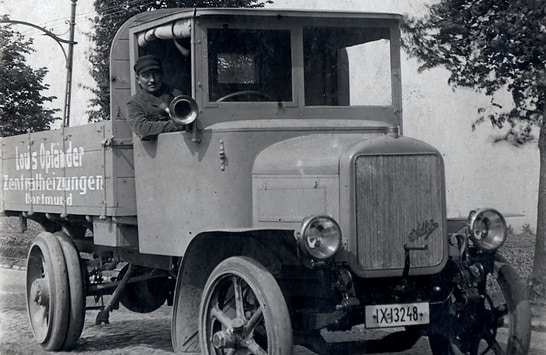
Louis Opländer, central heating in Dortmund
Although central steam heating did already exist in a sense, it only offered a limited degree of comfort due to the technical standards of the time.
Gravity-fed hot-water heating was an approach that aimed to improve the heat supply of the time, but it initially only worked in small-scale systems. The concept of the hot-water heating system was subsequently developed to achieve the most even heat distribution possible. Through the development and manufacture of steam and hot-water heating systems, the company ‘Louis Opländer’ increasingly made a name for itself in the central heating sector. The life’s work of the manufacturer Louis Opländer encompasses numerous technical innovations, the first of which came shortly after the turn of the century: a machine for calculating the volume of barrels.
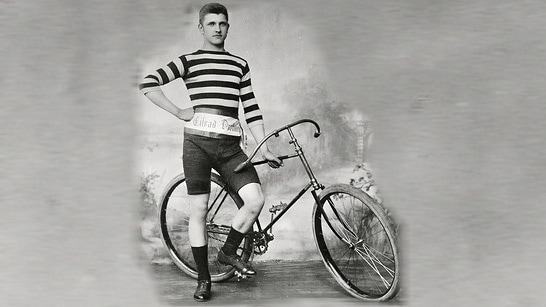
Louis Opländer wearing the jersey of the cycling association “Eilrad Dortmund”
In his private life, too, Louis Opländer was a very open-minded person who took an interest in everything new. He was a passionate sportsman: for instance, riding his racing bike in the 1880s, going skiing, a sport which had only just become fashionable, or rowing. In 1898, he witnessed the inauguration of the Dortmund Ems Canal, which increased his passion for the sport of rowing, and he became co-founder of the Dortmund-based rowing club Ruderclub Hansa e.V. Contemporary sources show just how important fairness was to Louis Opländer – including in his business dealings.


